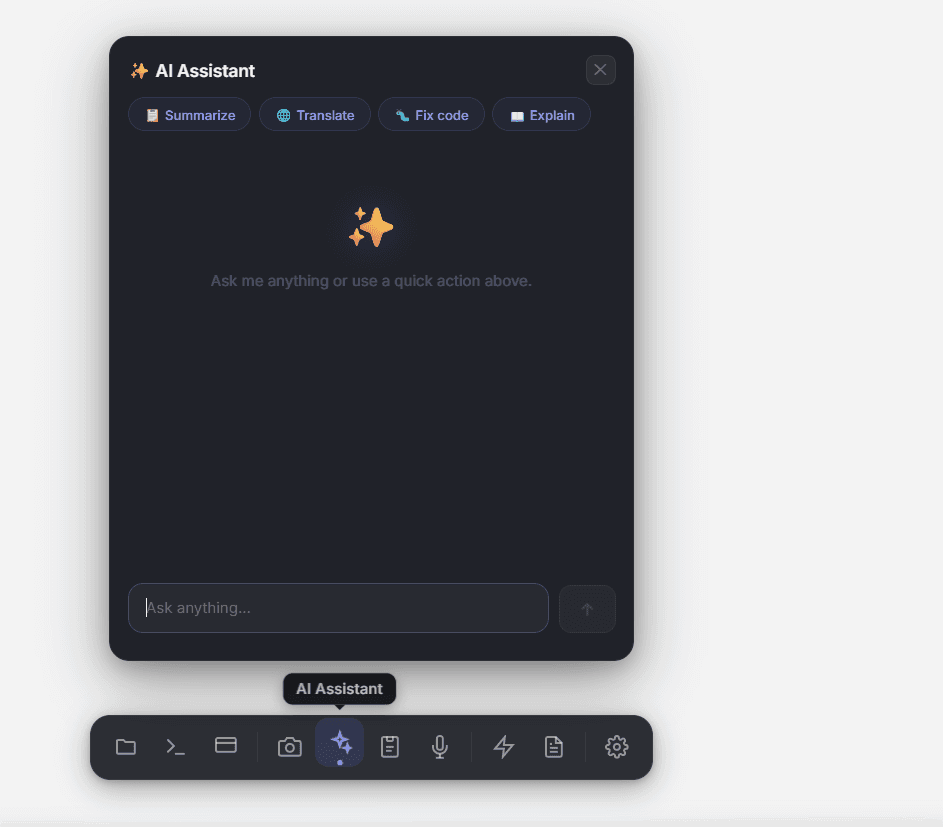
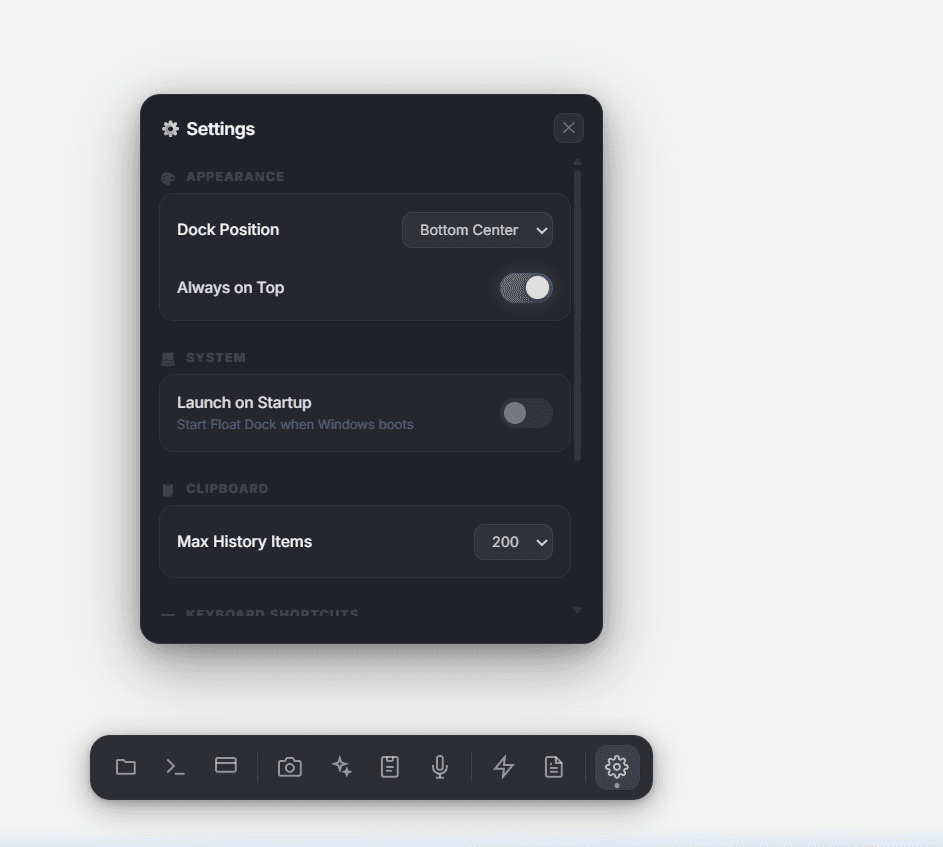
Traditional Windows desktop environments lack a cohesive, low-latency command center for developer workflows, forcing constant context switching between terminal sessions, clipboard buffers, and AI assistants. Float Dock resolves this by engineering an always-on-top, transparent, macOS-inspired overlay dock. It dynamically expands from a compact 480x140 trigger window to a full-screen interactive space on active icon selection, minimizing permanent visual clutter while maintaining immediate global hotkey accessibility.
Under the hood, the application is built on Electron 40, React 18, and Vite 5, adhering to a strict security model with context isolation, sandboxing enabled, and Node integration completely disabled. System integration is achieved through optimized IPC channels and custom native bridges: desktop capture pipelines leverage desktopCapturer with strict path-traversal validation, and the terminal integrates xterm.js with node-pty, lazy-loaded via createRequire to guarantee main-thread resilience. Desktop workspace snapshotting and restoration are powered by a low-level Win32 PowerShell execution model, capturing active application states and window coordinates for sub-second workspace recovery.
By opting for a high-performance React UI backed by inline styling and optimized CSS custom properties, the interface achieves fluid 60fps animations and hardware-accelerated rendering. To circumvent Windows Desktop Window Manager limitations regarding acrylic blur on transparent windows, a custom composite CSS backdrop-filter approach was implemented, preventing system-wide rendering lag. The architecture successfully isolates heavy sub-processes—like voice transcription and native shell sessions—maintaining an ultra-low idle memory footprint and sub-millisecond input latency.