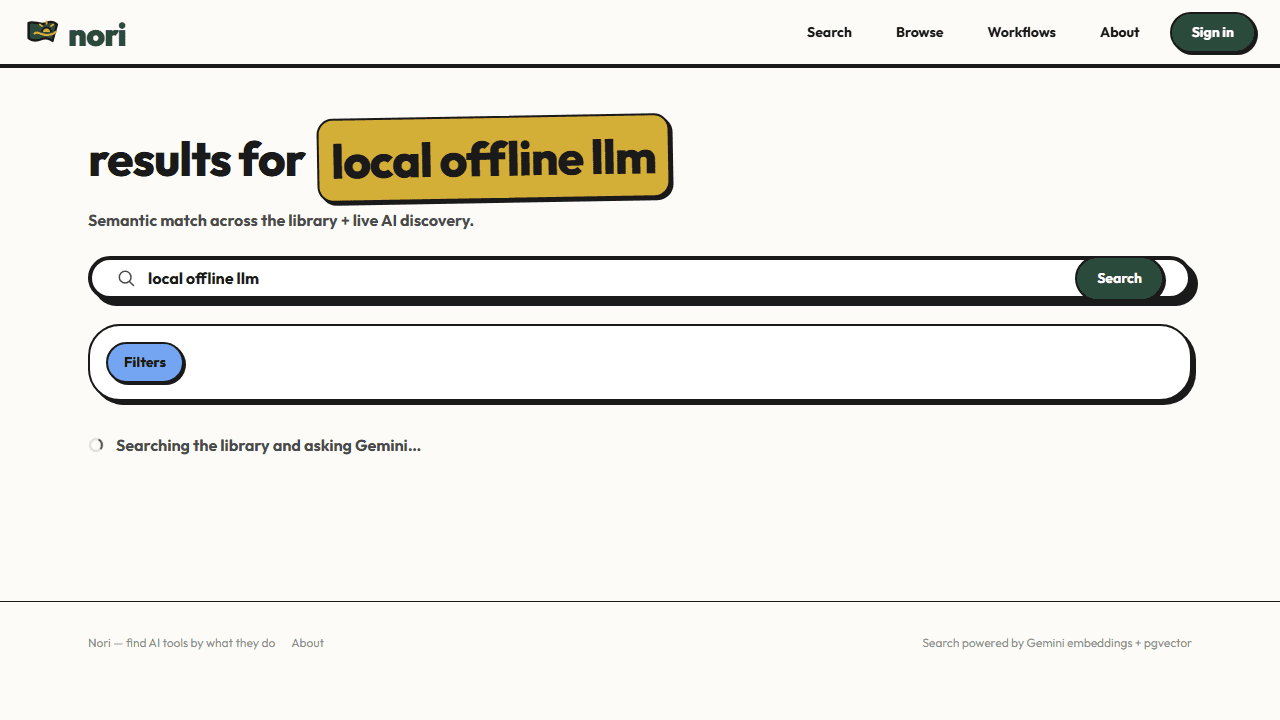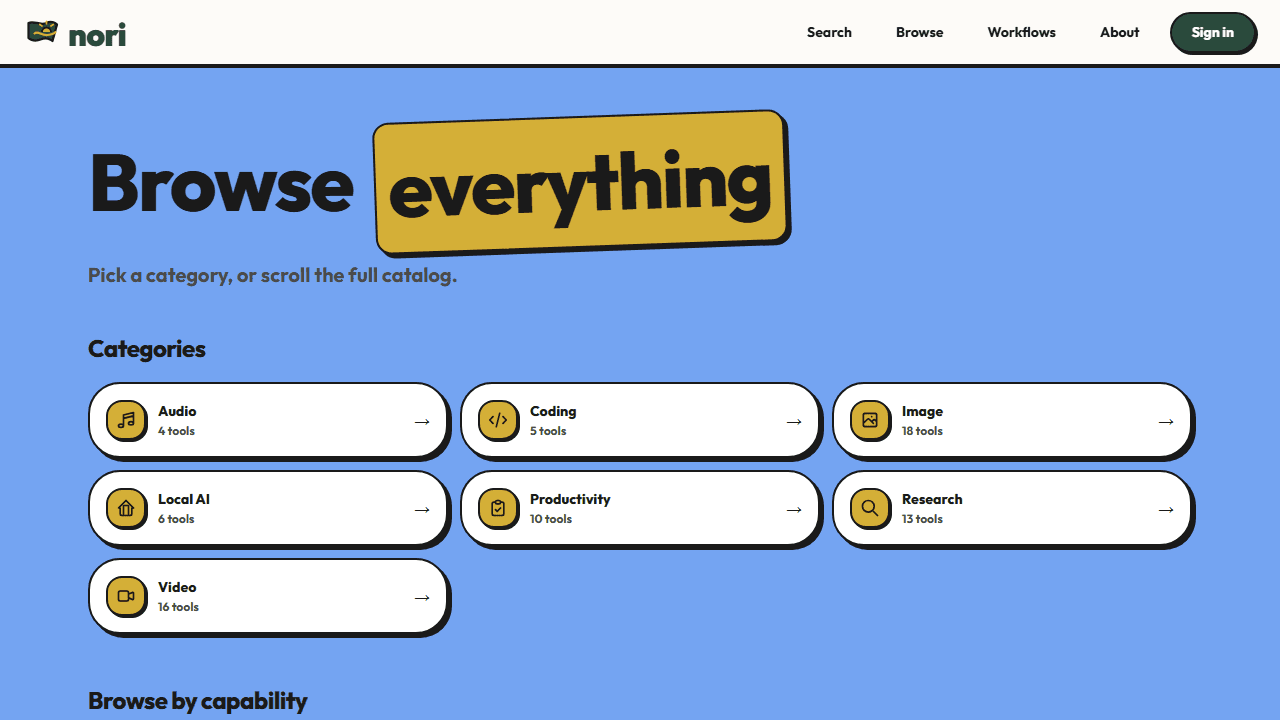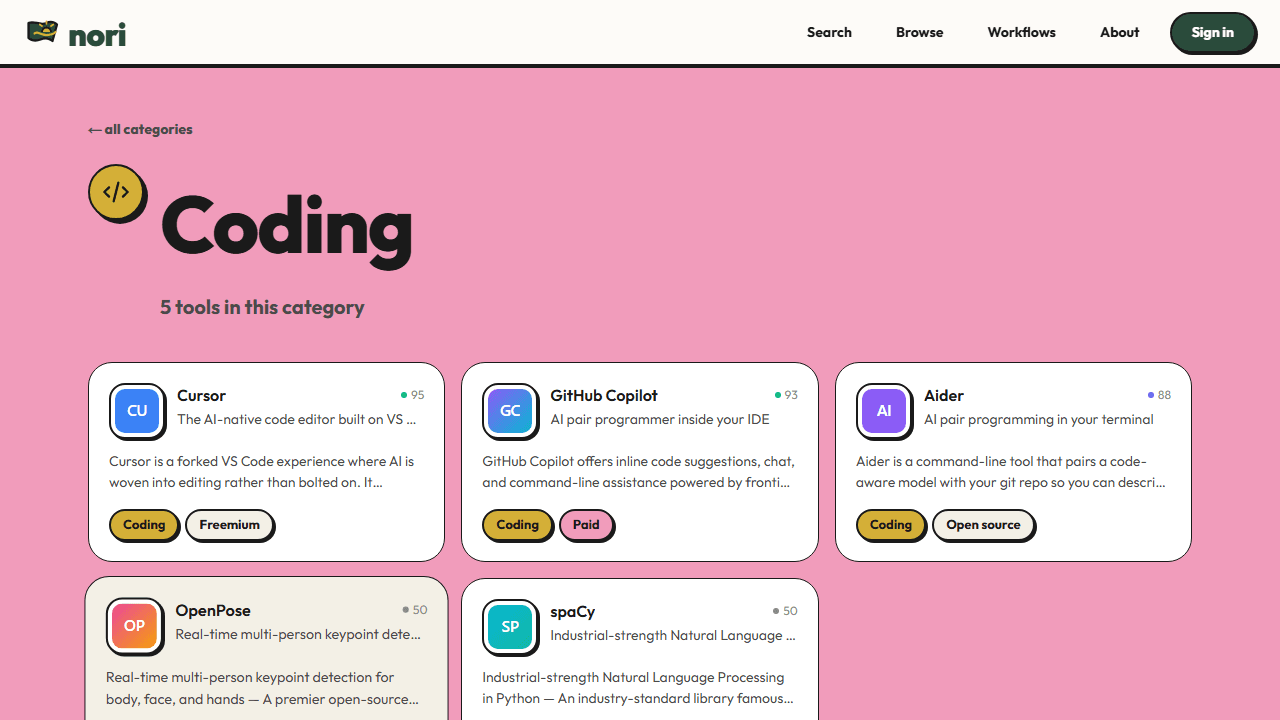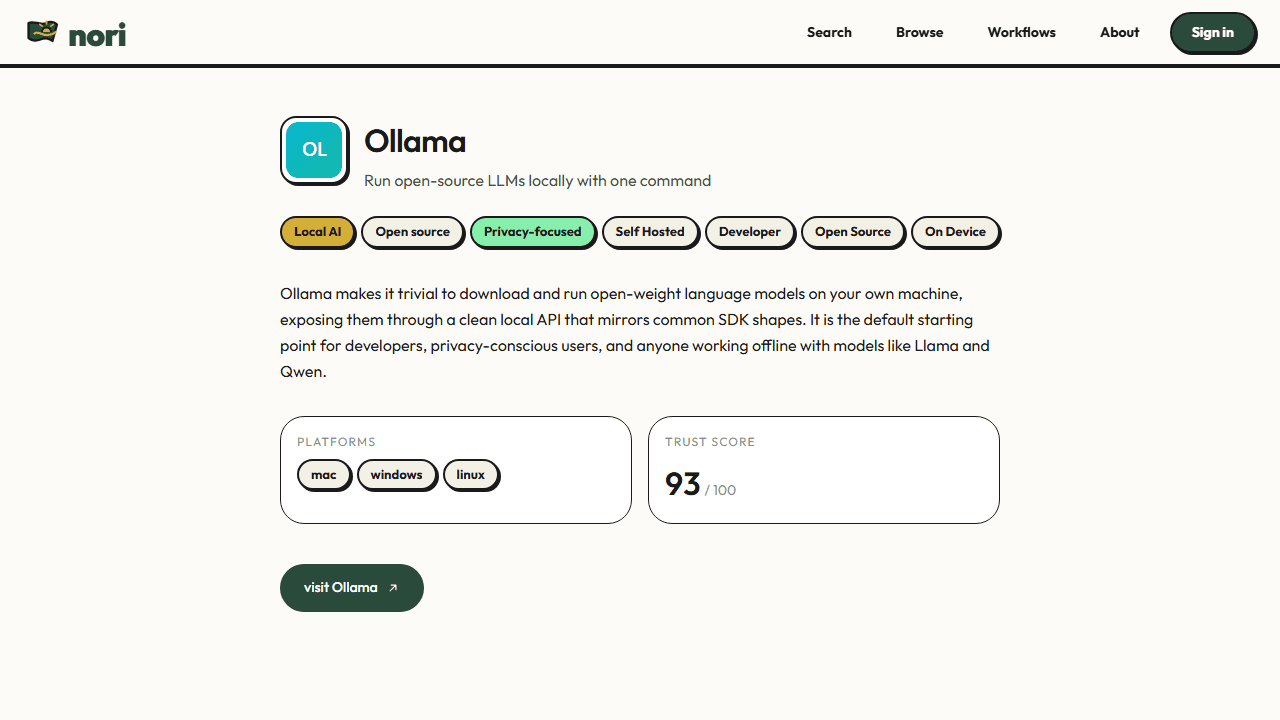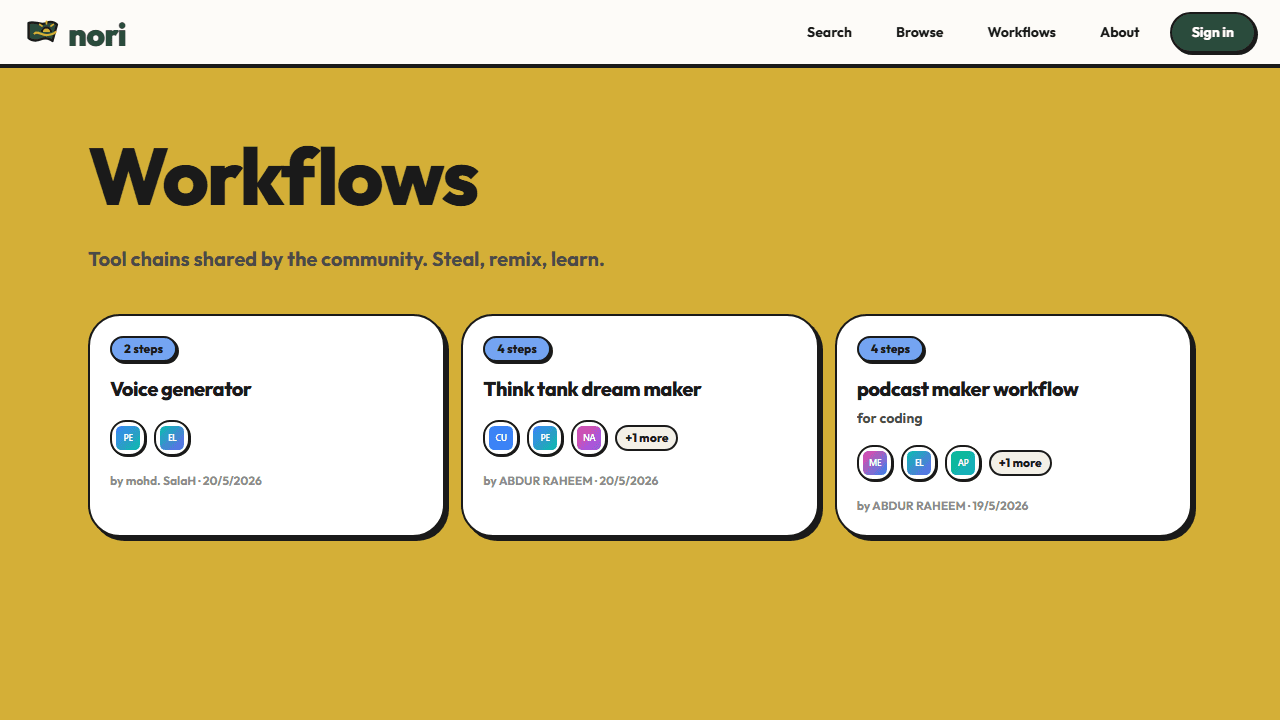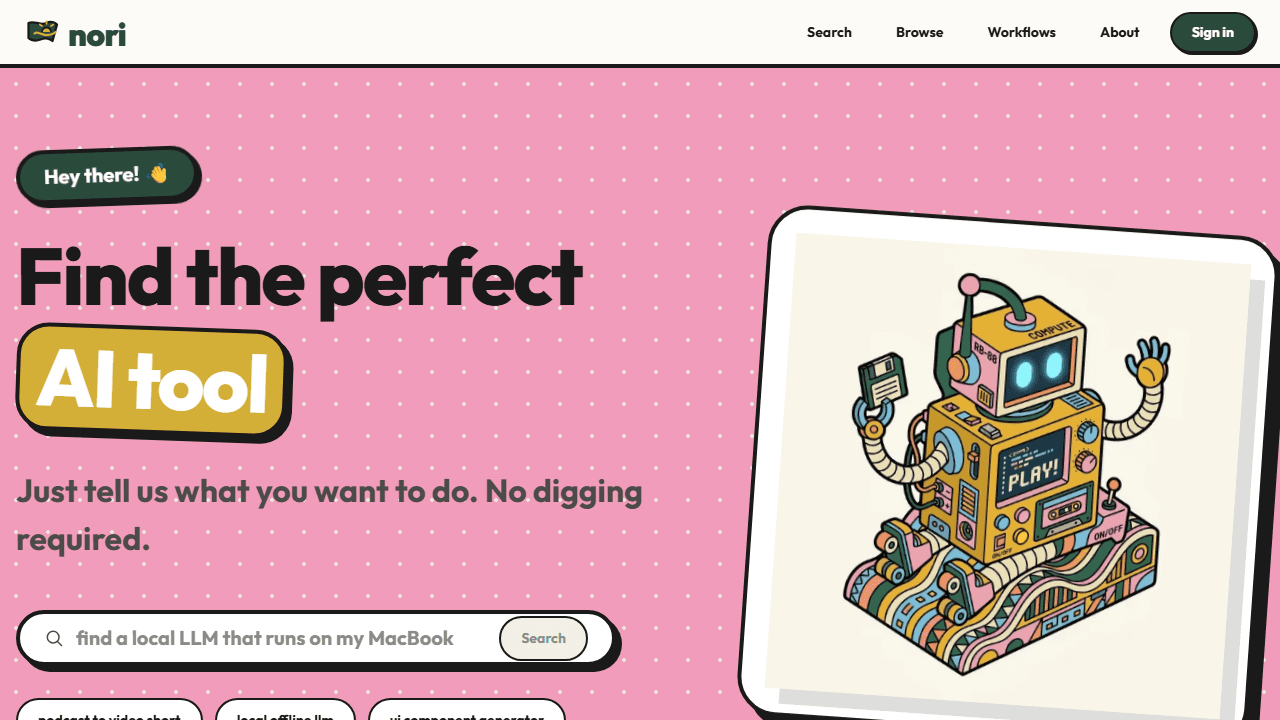
Discovering specialized developer tools and AI models has traditionally been bottlenecked by fragmented catalogs, rigid taxonomy, and lexical search limitations. Nori resolves this discoverability crisis by translating arbitrary user intent—such as 'turn a podcast into a YouTube short'—into functional, composable developer pipelines. The application combines high-fidelity semantic search over a local database with real-time LLM-driven discovery to index, structure, and orchestrate modern tools on an infinite visual canvas.
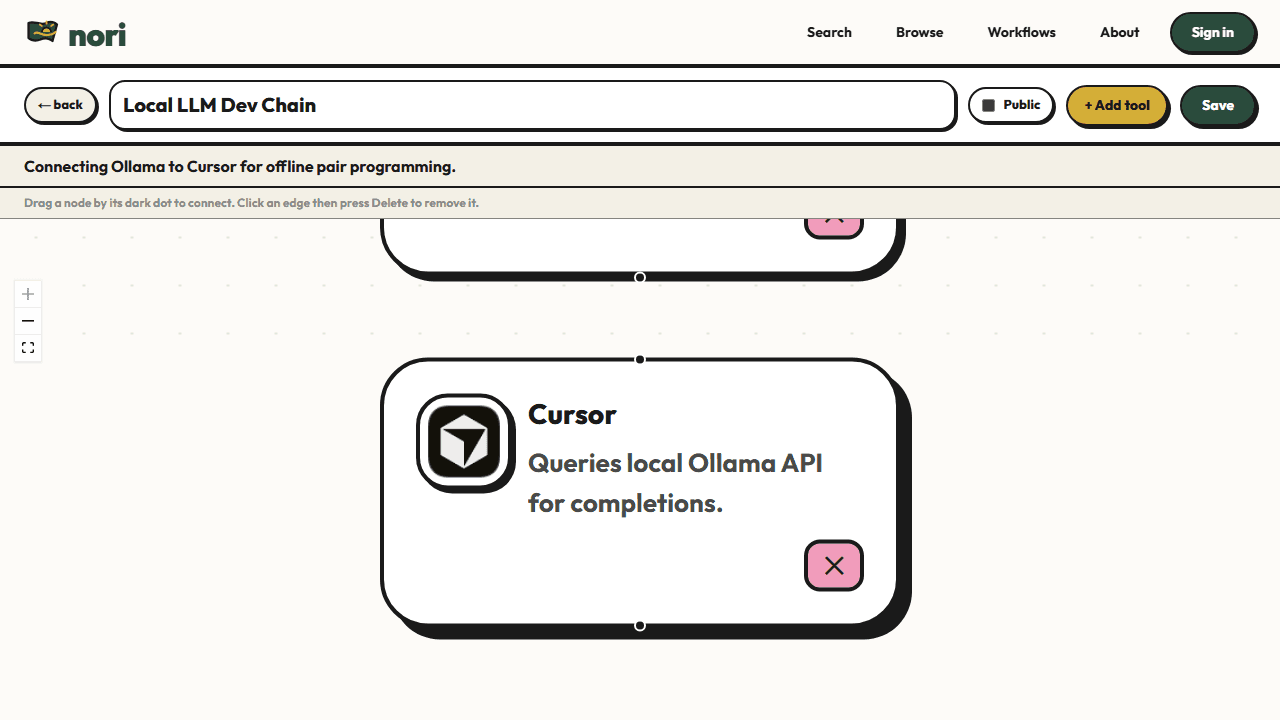
Under the hood, the core search pipeline runs on a highly optimized dual-path architecture. The primary path sanitizes and embeds queries into 768-dimensional Matryoshka-cut vectors via Gemini's embedding model, executing a high-performance cosine similarity search directly inside Neon PostgreSQL using parameterized raw SQL and the pgvector extension. A strict 0.62 similarity gate acts as a filter against noise and low-relevance results. In parallel, a 'live discovery' pipeline calls Gemini-Flash to search for unindexed tools on the open web, asynchronously slugifying, embedding, and persisting zero-day tools to the database for organic, self-scaling directory growth. Interactive workflows are built on a mount-gated React Flow canvas utilizing custom-rendered module-stable nodes and springy Framer Motion physics.
By uniting high-dimensional vector retrieval with real-time background indexing, the architecture eliminates the cold-start problem of curated directories. Local database queries settle in under 150ms, while the auto-persisting discovery engine offloads administrative overhead and ensures zero-day tools are indexed immediately on first query. The result is a self-growing directory that transforms unstructured search inputs into composable, shareable workflow visualizer maps.